

Why Thorough Perfume Testing is Essential
Properly evaluating fragrances extends far beyond a quick sniff from a bottle or a fleeting spray. A systematic approach to how to sample perfume is crucial for several reasons, helping you make a choice you’ll appreciate long-term.
Avoiding Buyer’s Remorse and Costly Perfume Mistakes
Many individuals have experienced the frustration of purchasing a full bottle of perfume only to discover later that it doesn’t suit them. This often stems from inadequate testing. A hasty decision can lead to significant financial waste and a bottle gathering dust. By understanding effective perfume testing tips, you can prevent these common avoiding perfume mistakes and invest wisely in a fragrance you’ll genuinely enjoy wearing.
Understanding Fragrance Evolution on Your Skin
Perfumes are complex compositions designed to evolve over time. They interact uniquely with individual body chemistry, which can significantly alter their scent profile. What smells appealing on a blotter strip or a friend might smell entirely different on you. This interaction makes testing perfume on skin vs paper an indispensable step, as it reveals the true character of a fragrance as it develops through its top, middle, and base notes.
Key Tools for Effective Perfume Sampling
To ensure you’re employing the best way to try perfume, it’s helpful to understand the tools and techniques that facilitate accurate assessment. These elements are fundamental to effective perfume testing tips.
The Role of Perfume Blotter Paper
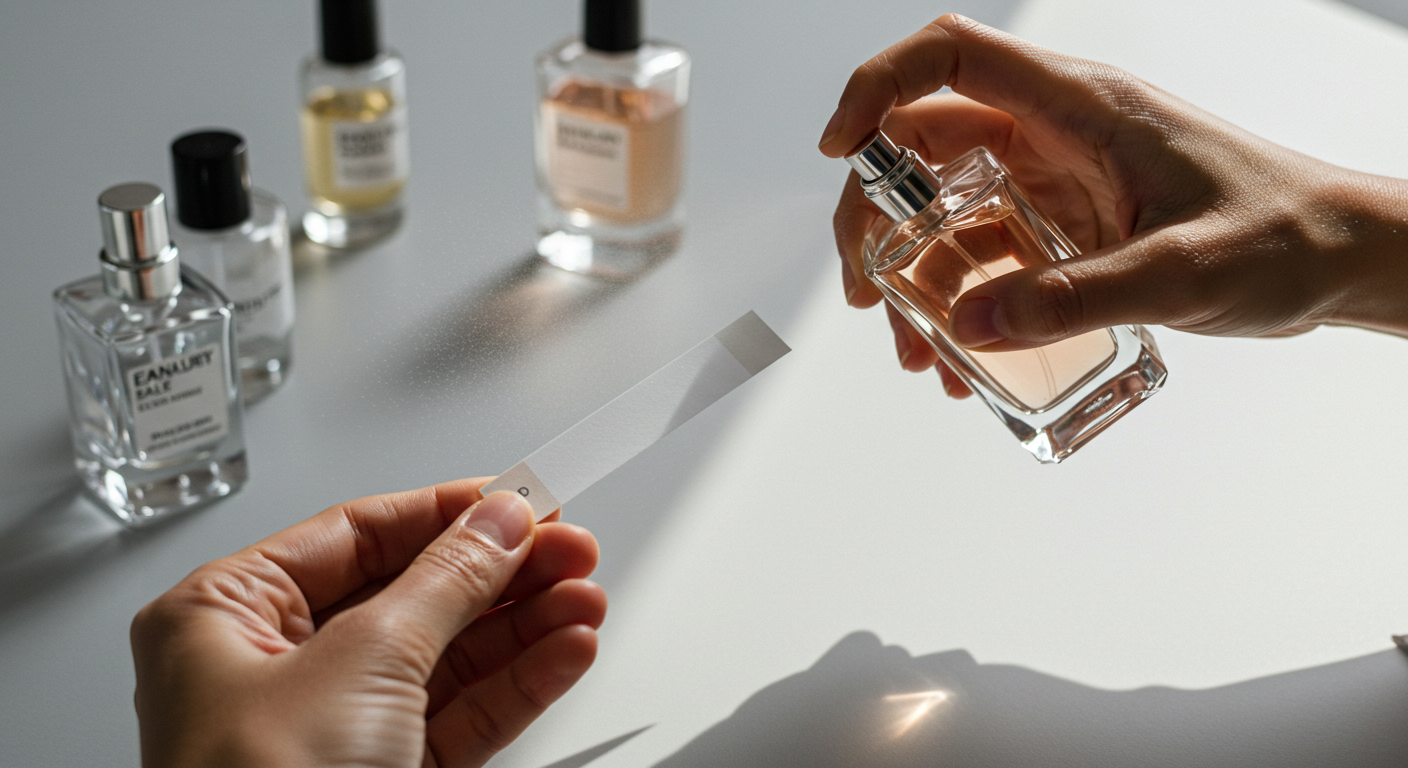
Perfume blotter paper, often provided in stores, serves as an excellent initial screening tool. It allows you to experience a fragrance’s opening notes without immediate commitment to your skin. Blotters are useful for narrowing down choices, especially when faced with a vast selection. They provide a clean canvas to gauge the initial impression and general scent family of a perfume, helping you decide which ones warrant further, more personal testing.
Your Skin: The Ultimate Testing Ground
While blotters offer a preliminary assessment, your skin is the definitive medium for evaluating a fragrance. The warmth, oils, and pH balance of your skin react with the perfume’s ingredients, causing it to develop and project uniquely. This personal interaction is why testing perfume on skin vs paper is non-negotiable for a true understanding of how a scent will perform on you. It’s where the fragrance truly comes alive and reveals its full story.
Cleansing Your Olfactory Palate
When sampling multiple fragrances, your sense of smell can quickly become fatigued, making it difficult to distinguish between scents. This is where olfactory palate cleansing becomes essential. The most common and effective method is to smell coffee beans, often provided in perfume stores. The strong, distinct aroma of coffee helps to reset your nasal receptors, allowing you to approach the next fragrance with a refreshed sense of smell. This simple yet crucial step is one of the most valuable perfume testing tips for accurate evaluation.
Step-by-Step: How to Test Perfume Effectively
A methodical approach is key to successfully determining how to test perfume before buying. Follow these steps for a comprehensive and accurate evaluation of any fragrance you consider.
Initial Assessment: The Blotter Paper First
Begin your fragrance exploration by spraying a small amount onto a piece of perfume blotter paper. Hold the blotter about six inches from your nose and take a gentle sniff. This allows you to experience the top notes and get a general idea of the scent’s character without overwhelming your senses. Label each blotter immediately to avoid confusion, especially if you’re sampling several options. This initial step helps you filter out scents that are clearly not to your taste.
Strategic Skin Application for Accurate Results
Once you’ve identified a few promising candidates from your blotter tests, it’s time for skin application. Choose a clean, pulse point area, such as your wrist or inner elbow. These areas are warm and help the fragrance develop. Apply one spray per area, ensuring you don’t apply more than one fragrance per limb. This allows for an isolated and accurate assessment of how the perfume interacts with your unique body chemistry, highlighting the importance of testing perfume on skin vs paper for a true impression.
The Waiting Game: Understanding Fragrance Stages
Perfumes are designed to evolve through three distinct stages: top, middle (heart), and base notes. The top notes are the initial burst, lasting typically 5-15 minutes. The middle notes emerge next, forming the core of the fragrance for 20-60 minutes. Finally, the base notes provide depth and longevity, lasting for several hours. To truly understand a fragrance, you must allow it to develop through all these stages. This means waiting at least 30 minutes, and ideally several hours, to experience its full evolution. Understanding how long to test perfume is crucial for a complete evaluation.
Tips for Testing Multiple Scents Without Overwhelm
When faced with many options, it’s easy to become overwhelmed. Limit yourself to testing no more than 3-4 fragrances on your skin at any one time, ideally one on each wrist and one on each inner elbow. Use perfume blotter paper for initial screening to narrow down your choices. Between each skin test, use coffee beans to reset your olfactory senses. If you’re still unsure, take a break and return another day. These perfume testing tips prevent olfactory fatigue and ensure each scent receives a fair evaluation.
Where to Test Fragrances: Your Sampling Options
Knowing where to test fragrances is as important as knowing how. Various venues offer different advantages for how to sample perfume, from in-person experiences to convenient at-home options.
In-Store Experiences: Department Stores and Boutiques
Department stores and beauty boutiques are traditional places where to test fragrances. They offer a wide selection of designer and sometimes niche perfumes, along with readily available blotter paper and often coffee beans. Sales associates can provide guidance, though their recommendations might be influenced by sales targets. The advantage here is the immediate access to a broad range of scents for initial impressions and skin testing.
Exploring Specialty Perfume Shops
Dedicated perfume shops, especially those focusing on niche or artisanal brands, offer a more curated and often educational experience. Staff in these stores are typically highly knowledgeable and passionate about fragrance, providing expert insights and personalized recommendations without high-pressure sales tactics. These environments are excellent places where to test fragrances that might be harder to find elsewhere, offering a deeper dive into the world of perfumery.
Convenience of Perfume Sample Kits and Online Decants
For those who prefer a more relaxed, at-home testing experience, perfume sample kits and online decants are invaluable. Many brands and online retailers offer discovery sets containing small vials of their popular fragrances. Decant services allow you to purchase small, authentic portions of full-sized bottles, often including high-end or rare scents. These options provide ample time to live with a fragrance for a full day or longer, making them an excellent way for how to sample perfume thoroughly before committing to a larger purchase.
Testing Perfume on Skin vs. Paper: A Detailed Comparison
The distinction between testing perfume on skin vs paper is fundamental to making an informed fragrance choice. Each method serves a different purpose and offers unique insights.
The Blotter’s Purpose and Limitations
Perfume blotter paper is designed to give you a clean, unadulterated impression of a fragrance’s initial notes. It’s excellent for quickly assessing the top notes and determining if a scent’s overall character aligns with your preferences. However, a blotter cannot replicate the warmth, oils, and pH of human skin. It won’t show you how the fragrance truly evolves, how long it lasts, or how it projects in a real-world scenario. Its purpose is primarily for initial screening and comparison of opening accords.
The Uniqueness of Skin Chemistry
Your skin is a living canvas that interacts dynamically with fragrance. Factors like body temperature, diet, medication, and natural skin oils all influence how a perfume smells and performs. This unique interaction means a fragrance can smell different on every individual. Testing perfume on skin vs paper is crucial because it reveals the true, personal scent profile that will accompany you throughout the day. It’s the only way to understand the full development, longevity, and sillage (the trail a fragrance leaves) of a scent as it interacts with your personal chemistry.
How Long to Test Perfume for a True Impression
Understanding how long to test perfume is critical for a comprehensive evaluation. A fragrance’s true character unfolds over time, and patience is key to appreciating its full spectrum.
Experiencing Top, Middle, and Base Notes
As mentioned, fragrances evolve through distinct stages. The top notes are fleeting, lasting minutes. The middle notes, the heart of the fragrance, can last for 1-3 hours. The base notes, which provide depth and anchor the scent, can linger for 4-8 hours or even longer, depending on the concentration and composition. To truly experience a fragrance, you need to allow it to develop through all these phases. This means wearing it for at least half a day, ideally a full day, to understand its complete journey. This extended wear time is essential for determining how long to test perfume before making a decision.
Assessing Longevity and Sillage
Beyond the scent itself, two crucial aspects to evaluate are longevity and sillage. Longevity refers to how long the fragrance remains detectable on your skin. Sillage describes the scent trail it leaves behind and how far it projects. These characteristics are highly personal and depend on both the perfume’s formulation and your skin chemistry. Only by wearing a fragrance for an extended period can you accurately assess its performance in these areas. Pay attention to how often you can smell it on yourself and if others notice it. These observations are vital perfume testing tips for finding a scent that meets your expectations for wearability.
Avoiding Common Perfume Testing Mistakes
Even with the best intentions, several common errors can hinder your ability to accurately assess a fragrance. Being aware of these pitfalls is key to avoiding perfume mistakes and ensuring effective perfume testing tips are applied.
The Dangers of Over-Spraying
A common mistake is applying too much perfume during testing. Over-spraying can overwhelm your olfactory senses, distort the true scent profile, and lead to a headache. A single, light spray on a designated test spot is sufficient. Remember, you’re trying to understand the fragrance’s nuances, not create a cloud of scent. This simple adjustment is crucial for avoiding perfume mistakes that can lead to misjudgment.
Why Testing Too Many Scents is Counterproductive
Your nose has a limited capacity for processing different scents before experiencing olfactory fatigue. Trying to evaluate too many perfumes in one session will blur your perception, making all fragrances seem similar or unpleasant. Limit your skin tests to 3-4 at most, and use blotters for initial screening. If you find yourself struggling to differentiate, take a break, step outside for fresh air, or smell coffee beans. This is one of the most important perfume testing tips for maintaining clarity.
The Myth of Rubbing Wrists Together
A widespread habit is to rub your wrists together after applying perfume. This action generates friction and heat, which can prematurely break down the fragrance molecules, especially the delicate top notes. It can alter the scent’s intended development and shorten its longevity. Instead, allow the perfume to air dry naturally on your skin. This seemingly small detail is a significant factor in avoiding perfume mistakes that compromise the integrity of the scent.
Ignoring Personal Body Chemistry
Relying solely on how a perfume smells on a blotter, or even on someone else, is a significant oversight. As discussed, individual body chemistry plays a pivotal role in how a fragrance develops. Neglecting to perform a proper skin test means you’re not truly experiencing the perfume as it will smell on you. This reinforces the critical importance of testing perfume on skin vs paper for a personalized and accurate assessment.
Your Ultimate Fragrance Shopping Guide
Armed with comprehensive knowledge on how to test perfume before buying, you’re ready to navigate the world of fragrance with confidence. This fragrance shopping guide consolidates the best practices for finding your ideal scent.
Considering Occasion and Season
Think about when and where you intend to wear the fragrance. Lighter, fresher scents are often preferred for daytime and warmer weather, while richer, heavier compositions might be more suitable for evenings or colder months. Consider your lifestyle and the environments you frequent. A versatile scent might work for many occasions, or you might prefer a wardrobe of fragrances for different contexts. This consideration is a key part of any effective fragrance shopping guide.
Navigating Fragrance Families and Notes
Familiarize yourself with basic fragrance families (e.g., floral, oriental, woody, fresh, fougère, chypre). Understanding which notes you generally enjoy (e.g., citrus, vanilla, rose, sandalwood) can help narrow down your search. While not strictly necessary for every purchase, this knowledge can guide you towards categories that typically appeal to you, making the process of finding the best way to try perfume more efficient.
The Importance of a Full Wear Test
Before making a final purchase, always perform a full wear test. This means wearing a sample of the fragrance for an entire day, experiencing its evolution from top to base notes, and observing its longevity and sillage in your daily activities. Pay attention to how you feel wearing it and if you still enjoy it after several hours. This extended trial is the ultimate step in determining how long to test perfume to ensure it’s the right fit for you.
FAQ: Your Questions About Perfume Testing Answered
Here are answers to common questions about how to test perfume before buying, providing additional perfume testing tips for a successful experience.
Can I test perfume on clothes?
While you can spray perfume on clothes, it’s not ideal for testing its true scent profile. Fabric doesn’t interact with fragrance in the same way skin does, meaning the scent won’t evolve naturally. Additionally, some perfumes can stain delicate fabrics. For a true test, always prioritize skin application.
What’s the best time of day to test perfume?
Your sense of smell is often keenest in the morning, making it an ideal time for fragrance testing. Avoid testing immediately after eating strong-smelling foods or when you have a cold or allergies, as these can impair your olfactory perception.
How many perfumes can I test at once?
To avoid olfactory fatigue, limit yourself to testing no more than 3-4 fragrances on your skin at a time. Use blotter strips for initial screening of a larger selection, but reserve skin for the most promising candidates. Remember to cleanse your palate between scents.
Making Your Signature Scent Selection with Confidence
Choosing a fragrance is an intimate decision that deserves careful consideration. By understanding how to test perfume before buying, you empower yourself to make a choice that brings lasting pleasure. Employing effective perfume testing tips, such as utilizing blotter paper for initial impressions, strategically applying scents to your skin, and allowing ample time for full development, ensures you experience a fragrance’s true character. Whether you explore options in a bustling department store, a serene specialty boutique, or through convenient perfume sample kits at home, a patient and informed approach is the best way to try perfume. Embrace the process, trust your senses, and confidently select a signature scent that truly reflects you.